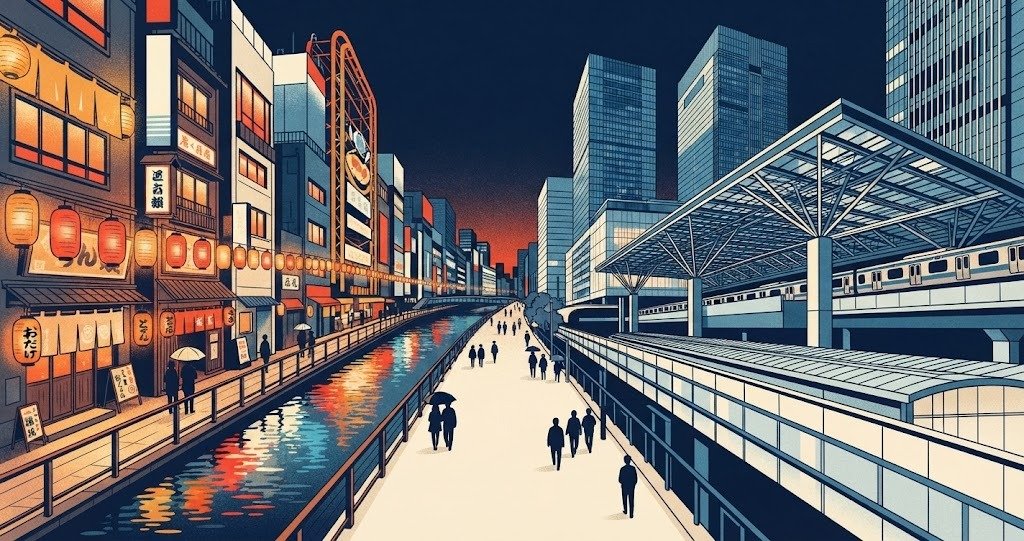
Choose Namba if your Osaka trip revolves around food, Dotonbori evenings, and walking back after dinner. Choose Umeda if you expect frequent trips to Kyoto or Kobe and want a base around Osaka’s northern rail hub. Both offer excellent dining and transport; the better choice depends on the journeys you will repeat.
One detail matters more than the neighborhood label: the station entrance closest to your hotel. “Near Namba” and “near Osaka Station” can describe very different walks, especially with luggage.
Start with your evening plans, then check your airport route and day trips. That order usually makes the decision easier.
Namba or Umeda: which fits your itinerary?
Namba is the stronger starting point for a short, food-focused Osaka stay. Umeda deserves a closer look when Osaka is also your base for exploring nearby cities. Neither requires you to give up the other: Osaka Metro’s Midosuji Line connects Namba and Umeda directly, so visiting both is straightforward.
| Priority | Namba | Umeda |
| Evening atmosphere | Dotonbori, restaurant streets, and canal-side activity | Restaurants, department stores, and a major station district |
| Food exploration | A convenient base for Dotonbori and nearby Kuromon Market | Strong department-store dining and food-hall options |
| Kansai Airport arrival | Direct Nankai services to Nankai Namba | Direct JR options to Osaka Station |
| Kyoto and Kobe outings | Possible, but compare transfers for your destination | A useful base for JR and Hankyu routes |
| Nara outing | Direct Kintetsu services from Osaka-Namba | Compare the full route before booking |
| Main booking pitfall | Assuming all stations named Namba share one entrance | Underestimating the walk across the Osaka/Umeda station area |
Treat this as a way to narrow the search, not a ranking of every hotel. A well-positioned property in either neighborhood can work better than a cheaper room with an awkward daily walk.
Where will you enjoy eating more?
Pick Namba for the experience of exploring restaurant streets and returning to Dotonbori after dark. Pick Umeda if department-store food halls and meals around a transport hub fit your routine. Food quality does not belong to one neighborhood; what changes is how dining fits into your day.
Namba makes the evening part easy
Dotonbori is the obvious draw, with its oversized signs, restaurants, and canal-side setting. Staying nearby lets you visit without making every dinner dependent on a return train journey.
That flexibility is useful when you want to browse before choosing somewhere to eat. You can also return to the hotel between sightseeing and dinner rather than carrying shopping bags through the evening.
Kuromon Market adds a different food stop in nearby Nipponbashi. Osaka’s official tourism guide identifies fresh fish, fruit, and prepared foods among its offerings, so it works as a separate market visit rather than a substitute for an evening restaurant plan.
Check individual opening hours. A market visit and a late dinner require different timing, and a busy district does not mean every business stays open late.
Umeda has more than convenient station food
Umeda is a serious option for travelers who like browsing several food choices under one roof. Hanshin Umeda’s basement Snack Park, for example, lists noodle shops, sushi, rice bowls, and its signature ikayaki among the choices.
That gives you a concrete alternative to planning every meal around a well-known restaurant. It can also fit naturally around a shopping stop or your return from a day trip.
Check the dining format before settling on a venue. Snack Park emphasizes standing dining, which may be less suitable when you want a long, seated meal after walking all day.
The deciding question: do you want to spend your evenings wandering around Minami, or would you rather finish the day near your northern transport base? Answer that before comparing hotel photographs.
Which area makes your train journeys easier?
Umeda is particularly useful for Kyoto and Kobe travel, while Namba offers a strong combination of airport access and Kintetsu connections toward Nara. For travel within Osaka, both work well. Compare actual departure and arrival stations rather than assuming one neighborhood is best for every destination.
From Kansai International Airport
Nankai connects Kansai Airport with Nankai Namba. Its Rapi:t limited express requires a limited-express ticket in addition to the basic fare; compare the available services when planning your arrival.
Umeda also has a direct airport option. JR’s HARUKA serves Osaka Station, so staying north does not automatically mean changing trains after a flight.
Check the station-to-hotel portion as carefully as the train ride. A direct service is convenient, but the advantage shrinks if you then face a long walk with bags or choose the wrong exit.
These routes concern Kansai International Airport. If your flight uses Itami Airport, plan that journey separately rather than applying Kansai directions.
For Kyoto, Kobe, and Nara
Hankyu’s network connects Osaka-Umeda with Kyoto and Kobe, while JR Osaka Station provides additional regional options. This makes Umeda worth prioritizing when several mornings start with an out-of-town train.
For Kyoto, search the place you actually intend to visit. Kyoto Station and Kyoto-Kawaramachi are different arrival points, and the better route depends on what comes next.
Namba remains a practical choice for Nara. Kintetsu operates services between Osaka-Namba and Kintetsu-Nara, so you should not select Umeda solely because a guide describes it as the “day-trip area.”
For travel around Osaka
The Midosuji Line connects both neighborhoods with Shin-Osaka and Tennoji. You can therefore stay in one district and visit the other without transferring between subway lines.
Remember that Osaka Station and Shin-Osaka Station are different places. Check the station printed on your intercity ticket rather than assuming that a hotel beside Osaka Station puts you beside your Shinkansen departure platform.
What does “near the station” really mean?
A useful hotel location puts you near the station and entrance you will actually use. Namba includes several operators’ stations, while Umeda combines JR Osaka Station with nearby private-railway and subway stations. A map pin beside the wider complex does not tell you the full walking route.
In Namba, distinguish Nankai Namba, Osaka-Namba, JR Namba, and the Metro stations. For an airport-focused stay, look specifically at the route from Nankai’s platforms to the hotel.
Swissôtel Nankai Osaka illustrates this distinction: its official description places it above Nankai Railway’s Namba Station. That is a specific location advantage, rather than a general claim that it is the best hotel in the district.
In Umeda, Hotel Granvia Osaka provides a comparable example through its direct connection to JR Osaka Station. That connection is relevant if JR departures feature heavily in your plans, but you should still check the route to your particular platform.
When comparing hotels in Osaka, shortlist properties by these practical routes. Compare room size, bed configuration, and cancellation terms only after confirming that the location supports your itinerary.
How should you make the final booking decision?
Choose the area that simplifies your most frequent journeys, then compare equivalent rooms for your dates. Neither Namba nor Umeda is always cheaper or quieter. The individual street, building, room position, and booking conditions can matter more than the broad neighborhood name once you have narrowed your options.
Before booking through Gother or another accommodation platform, run through these checks:
- List your likely evenings. Several nights around Dotonbori favor Namba; repeated returns to Osaka Station favor Umeda.
- Map the hotel entrance. Check the actual walking route, including elevator access if you have luggage or a stroller.
- Compare the same room requirements. Match occupancy, bed type, breakfast, cancellation conditions, and the total price shown for your dates.
- Read recent, specific reviews. Look for comments about room noise, luggage space, and the station walk rather than relying only on an overall score.
- Check your departure morning. An early flight or train may make one hotel materially easier than another in the same neighborhood.
For a short stay, there is usually little reason to move hotels simply to experience both districts. Keep one base and use the direct subway connection to explore the other.
Choose Namba for an Osaka trip organized around eating and exploring Minami. Choose Umeda when regional train journeys shape your schedule. Then make the final choice at street level: the right hotel entrance, a suitable room, and an easy route back at the end of the day.