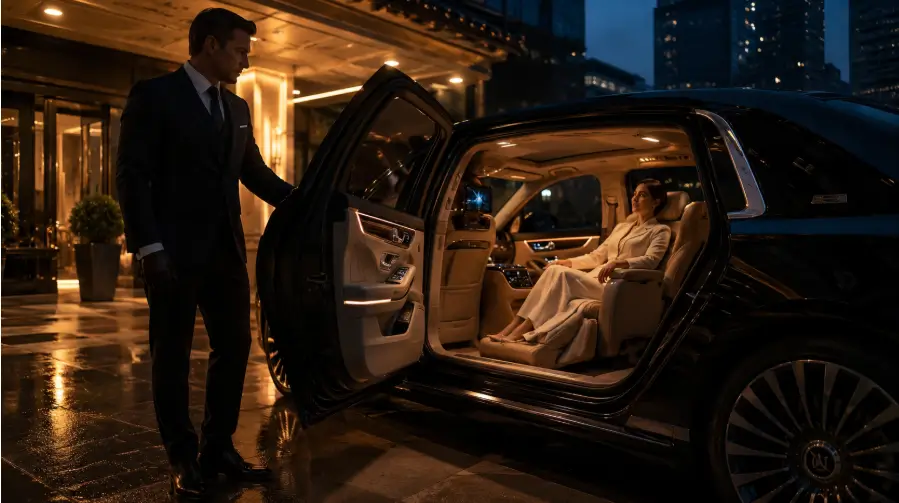
Luxury mobility has traditionally been defined by performance, prestige, and engineering excellence. The emphasis was often on how a car drove, how it responded, and how it made the driver feel behind the wheel.
But in the upper tiers of modern automotive design, a quiet reversal is taking place. For many luxury vehicles today, the most important seat is no longer the driver’s seat—it is the rear seat.
This shift reflects a broader rethinking of what luxury mobility means. Increasingly, the experience is less about driving engagement and more about comfort, privacy, productivity, and time well spent in transit.
The Return of the Chauffeur Mindset
Chauffeur-driven transport is not new. For decades, it has represented status, convenience, and a clear separation between control and comfort. What has changed is how mainstream this mindset is becoming among luxury consumers.
In major cities, it is increasingly common for high-end vehicles to be used with drivers rather than driven by their owners. This is not limited to formal chauffeur services; it also includes corporate mobility, executive transport, and lifestyle-driven usage patterns where time is treated as a premium resource.
The key shift is psychological. Luxury is no longer defined solely by control of the vehicle, but by control of personal time.
Rear-Seat Design as the New Priority
Automotive design has responded accordingly.
In traditional performance-oriented vehicles, the driver’s interface dominates the cabin. Controls are oriented toward engagement, feedback, and responsiveness. In chauffeur-focused vehicles, the priorities shift entirely.
Rear-seat comfort becomes central. This includes:
- Extended legroom and reclined seating positions
- Adjustable climate zones for individual passengers
- Integrated entertainment and productivity systems
- Noise insulation designed to create near-silent environments
- Materials chosen for tactile comfort rather than visual aggression
Some manufacturers now design entire vehicles around the rear passenger experience first, with the driver’s interface adapted to support smooth, unobtrusive operation rather than engagement.
This represents a fundamental change in design philosophy: the car is no longer a cockpit, but a mobile interior space.
The Car as a Mobile Environment
One of the most significant developments in luxury mobility is the treatment of the car as an extension of interior architecture.
Rather than focusing on driving dynamics alone, designers now consider how time is spent inside the vehicle. This includes lighting, acoustics, spatial perception, and even psychological comfort.
Ambient lighting systems are tuned to reduce fatigue during longer journeys. Cabin acoustics are engineered to eliminate road noise without creating artificial silence that feels unnatural. Seating positions are designed to support both relaxation and focused work.
In this sense, the vehicle becomes a transitional environment—part lounge, part office, part private retreat.
Technology and the Silent Driver
Advanced driver assistance systems have played a major role in enabling this shift.
While full autonomy remains in development, current systems already allow for semi-automated driving in controlled conditions. Adaptive cruise control, lane-centering assistance, and traffic-aware navigation reduce the cognitive load on the driver, smoothing the experience of being driven.
Even in chauffeur-driven contexts, these systems matter. They contribute to smoother acceleration, more consistent braking, and improved passenger comfort.
The goal is no longer just to move passengers efficiently, but to make movement itself feel effortless.
Time as the True Luxury Metric
A defining characteristic of modern luxury mobility is the reframing of time as the primary asset.
In congested urban environments, travel time is no longer viewed purely as delay. Instead, it is treated as recoverable time—an opportunity for rest, work, or privacy.
Rear-seat productivity systems allow passengers to conduct meetings, manage communications, or simply disconnect from external demands. Entertainment systems are increasingly tailored to personalised content ecosystems rather than generic media playback.
The result is that travel time is partially reclaimed as usable time, even in motion.
This is one of the key reasons chauffeur-style mobility continues to grow in relevance, even outside traditional luxury markets.
The Subtle Shift in Status Symbols
Historically, driving the car oneself was often a symbol of control and engagement, particularly in performance-oriented segments.
Today, the symbolism is more nuanced.
Being driven can represent efficiency, status, and detachment from logistical constraints. In certain contexts, it signals that time is more valuable than the act of driving itself.
This does not diminish driving enthusiasm in enthusiast communities, but it does reflect a diversification of what automotive status represents.
Luxury mobility now exists on a spectrum between driver engagement and passenger optimisation.
Cultural Variations in Chauffeur-First Design
The importance of rear-seat experience varies significantly by region.
In parts of East Asia, rear-seat-first luxury design has long been dominant, reflecting business culture and urban mobility patterns. In Europe, chauffeur-driven luxury has historically been associated with formal or executive use. In other regions, personal driving still remains central to luxury identity.
However, globalisation of automotive design is blending these expectations. Manufacturers now design vehicles that can serve both driver-centric and passenger-centric roles depending on market and configuration.
This flexibility has become a key requirement in modern luxury platforms.
See also: Egypt Is Becoming One of the Most Experience-Driven Destinations in Global Travel
Identity and Subtle Expression in Chauffeur Culture
Even in chauffeur-driven contexts, vehicle identity remains important. Exterior design, proportions, and subtle detailing continue to communicate status and brand philosophy, even when the owner is not behind the wheel.
Within this broader ecosystem of automotive identity and presentation, small design and identification elements still contribute to how vehicles are perceived in public space. In that context, companies such as Plates Express sit within the wider landscape of automotive expression, where detail, presentation, and identity continue to matter even as the driving experience becomes secondary.
Conclusion
The chauffeur experience is being redefined by a broader shift in how luxury mobility is understood. The emphasis is moving away from driving engagement and toward the quality of time spent inside the vehicle.
Rear-seat design, cabin architecture, and digital comfort systems are now central to how luxury cars are conceived. At the same time, technology is reducing the friction of travel, making movement itself feel more seamless and less demanding.
In this emerging model, the car is no longer just a machine for driving. It is a space for living, working, and resting while in motion.
As this trend continues, the most important question in luxury automotive design may no longer be how a car drives—but how it makes passengers feel while they are not driving at all.